
The Triceps Extension
Wonderful arm exercise in midlife

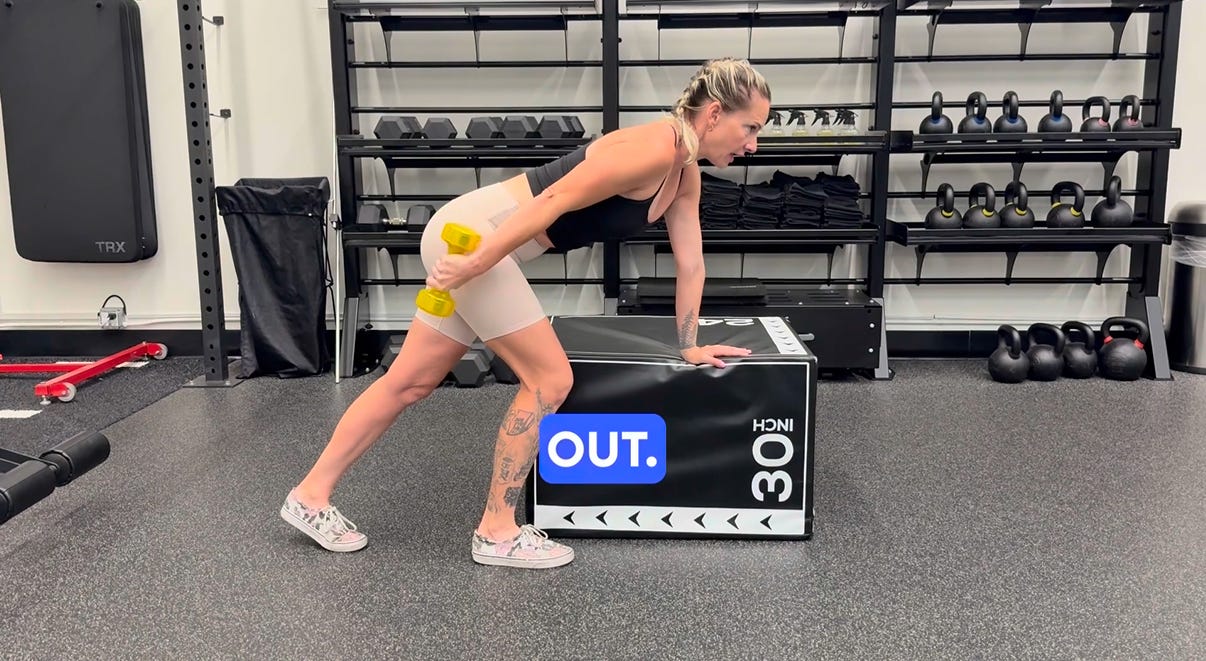
Not overhead. Not behind the head. This is the supported one-arm triceps extension using a bench or box.
If you want to train your arms without turning it into a neck, shoulder, or low back compensation fest, this is a great option.
This variation gives you more support, more control, and often a better chance of actually feeling the triceps do the work.
And in midlife, that matters.
A lot of women are not limited by effort. They are limited by positions that do not feel great on their joints, shoulders, or spine. When you create more stability, you often create a better strength stimulus too.
This is one of those exercises that looks simple. But when you do it well, it burns.
Why it matters in midlife
The triceps help with every pushing movement you do. They support pressing strength, getting up off the floor, pushing yourself out of a chair, stabilizing the elbow, and building upper body strength that carries over into daily life.
For women in midlife, upper body strength is often something we need more of, not less of.
A lot of women are doing random arm exercises for the burn, but not actually progressing their strength. This is a more controlled way to build that strength while keeping the setup simple.
I also like this exercise because the bench support can help reduce the tendency to arch through the back or swing the weight around, which makes it easier to keep tension where you want it.
What muscles it works
Primarily the triceps, especially as you extend the elbow under control.
You will also get help from the muscles that stabilize the shoulder and upper arm, but the goal is to keep the triceps as the star of the show.
Why I like this version
It gives you more support.
It helps you cheat less.
It makes it easier to actually feel the triceps working.
It can help clean up side-to-side differences.
It is often more comfortable than overhead triceps work.
This is a nice option for women who do not love overhead positions or who feel those versions more in the shoulders than in the arms.
How to set it up
Stand beside a bench or box and place one hand on it for support.
Both feet stay on the ground.
Hold a dumbbell in the free hand and hinge slightly forward so your torso is supported by the bench without collapsing into it.
Bring your working upper arm close to your torso with the elbow bent to about 90 degrees.
From there, straighten the elbow until the arm reaches long behind you.
Then return slowly to the start position.
The key is that the upper arm stays relatively still. The movement should happen at the elbow, not from the shoulder swinging back and forth.
Coaching cues
Keep the elbow high, but do not shrug the shoulder.
Pin the upper arm close to your side.
Straighten the arm fully at the back.
Pause briefly in the contracted position.
Lower the dumbbell slowly.
Do not swing the weight.
A good way to think about it is this: your upper arm is the anchor. Your forearm is the lever.
What I often see go wrong
The most common mistake is turning this into a full-arm swing instead of an elbow extension.
If the shoulder is rocking and the torso is twisting, the weight is probably too heavy.
Another common mistake is stopping short before full extension. If you never fully straighten the elbow, you miss the part of the rep where the triceps are really working.
And then there is the rushed lowering phase. The lowering matters. Control is where a lot of the training effect comes from.
How heavy should you go
Heavy enough that the last few reps feel challenging with clean form, but not so heavy that you need momentum.
For most women, starting lighter than you think and owning the position works far better than grabbing the heaviest dumbbell you can move.
When this is done well, it does not need to be flashy to be effective.
Where it fits in a workout
This works well after rows, presses, or a broader upper body block.
You can also pair it with a chest press, push-up variation, or row if you want a simple upper body finisher.
It is an accessory movement. But accessory work done consistently adds up.
A few programming ideas
2 to 4 sets of 8 to 15 reps per side.
Use a controlled lowering phase.
Stay a bit lower in reps if your goal is strength.
Go a bit higher in reps if your goal is muscle endurance or confidence with upper body work.
Who this is great for
Women who want stronger arms.
Women who do not love overhead triceps work.
Women who need more upper body confidence.
Women who tend to feel triceps exercises in the neck or shoulders instead.
Women who do better with a supported setup.
Bottom line
This is not just an arm-day extra.
It is a smart, stable way to build real upper body strength.
And sometimes that is exactly what makes an exercise more effective in midlife. Not more complexity. Better positioning.
Paid subscribers: Below you’ll find the video of the exercise, extra coaching cues, progressions, and alternatives.
