

The Sumo Squat
Why This Wide-Stance Variation Deserves a Permanent Spot in Your Training

If you’ve been squatting in a conventional stance your whole life, you’re leaving gains on the table. Not because conventional squats are wrong. They’re not. But the sumo squat hits your body differently, and for women in perimenopause and beyond, that difference matters.
Here’s what you need to know.
What Makes the Sumo Squat Different
The sumo squat uses a wide stance with toes pointed outward, typically between 30 and 45 degrees. Your feet are set wider than hip-width, sometimes significantly wider depending on your hip anatomy.
That setup changes the mechanics of the entire movement.
Your torso stays more upright than in a conventional squat. Your knees track outward over your toes. And the demand on your inner thighs, glutes, and hip abductors increases substantially.
You’re still in a squatting pattern. But you’re working different muscles harder, through a different range of motion.
What It Actually Trains
The sumo squat is a compound lower body exercise. The primary movers are the gluteus maximus (especially the lower fibers), the adductors (inner thigh muscles), the quadriceps, and the gluteus medius and minimus for hip stability.
The adductor loading is the key differentiator. Most squatting and hinging variations undertrain the inner thigh. The sumo stance changes that.
This matters because the adductors aren’t just aesthetic muscles. They contribute to hip stability, pelvic floor support, and knee tracking. Weakness there shows up in ways you might not connect to your inner thighs: knee cave during stairs, hip instability during single-leg work, pelvic floor dysfunction under load.
Why It’s Relevant in Menopause
Estrogen decline accelerates muscle loss in the lower body, particularly in the glutes and inner thighs. A 2015 study published in the Journal of Cachexia, Sarcopenia and Muscle found that postmenopausal women had significantly lower appendicular lean mass and muscle strength compared to premenopausal women, independent of body weight or physical activity levels (PMID: 25931040). The lower extremities take the biggest hit.
The sumo squat directly targets the tissue most at risk.
Research also supports wide-stance squatting for increased adductor and glute activation. A 2009 EMG study in the Journal of Strength and Conditioning Research confirmed that a wider stance produced greater gluteus maximus and adductor longus activation compared to narrow-stance variations, without a significant tradeoff in quadriceps recruitment (PMID: 19130643).
That’s evidence-based programming.
The sumo squat also tends to be more accessible than conventional squatting for women with limited ankle dorsiflexion, hip impingement, or a history of knee pain. The wider stance reduces forward lean, takes some demand off the ankles, and often feels more comfortable for women with wider hip anatomy. That’s not a workaround. That’s smart programming.
How to Do It
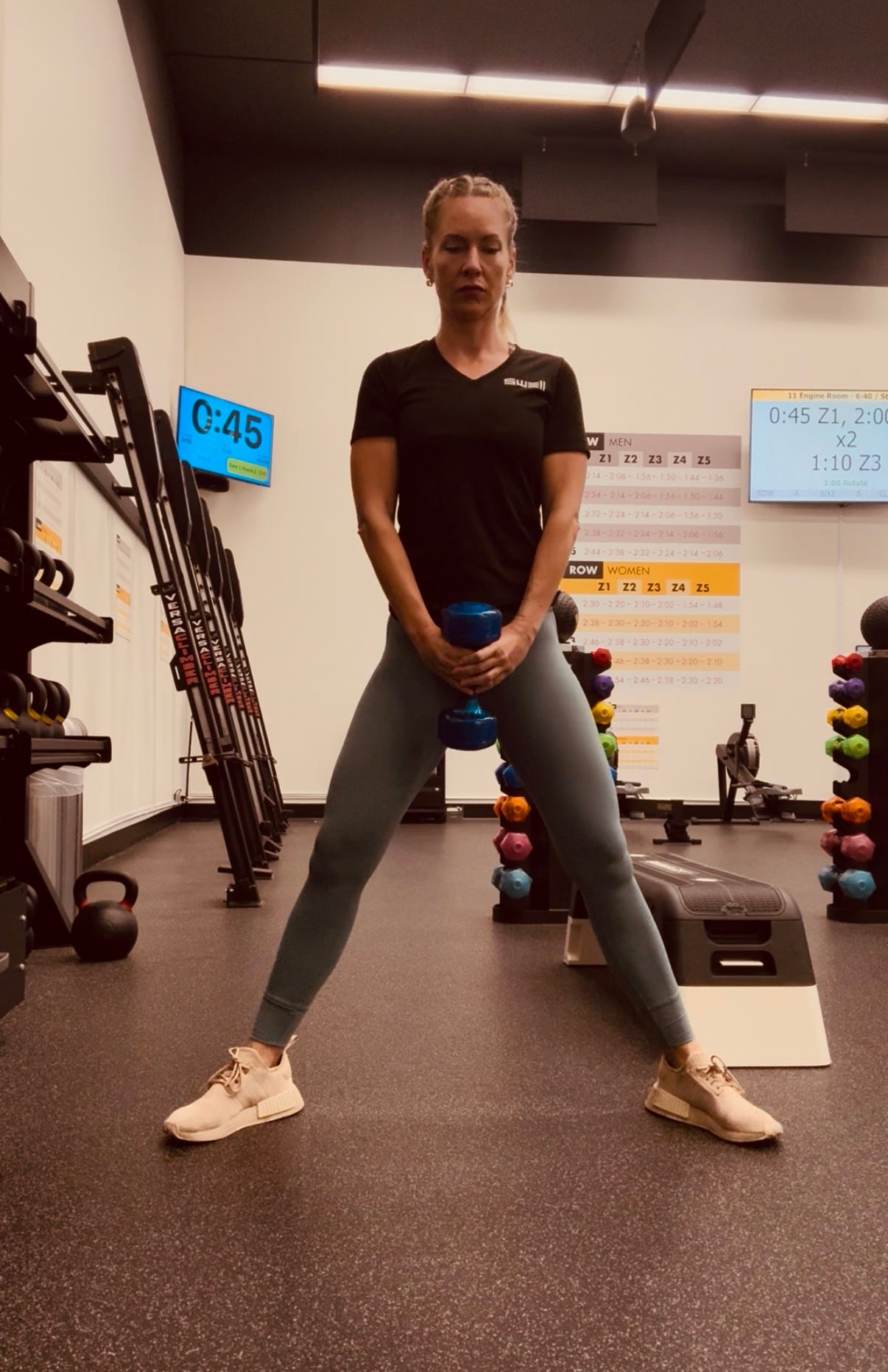
Set your feet wider than hip-width. Point your toes out to a comfortable angle: for most people, somewhere between 30 and 45 degrees. Your knees will follow your toes, so don’t force anything.
Brace your core before you descend. Think about creating tension through your entire midsection, not just sucking in your stomach.
Push your knees out as you lower. This is active. You’re not letting your knees cave and correcting it. You’re intentionally driving them outward the entire time.
Keep your chest up. The sumo squat should have a more upright torso than a conventional squat. If you’re folding forward significantly, your stance may be too narrow or your core brace isn’t strong enough yet.
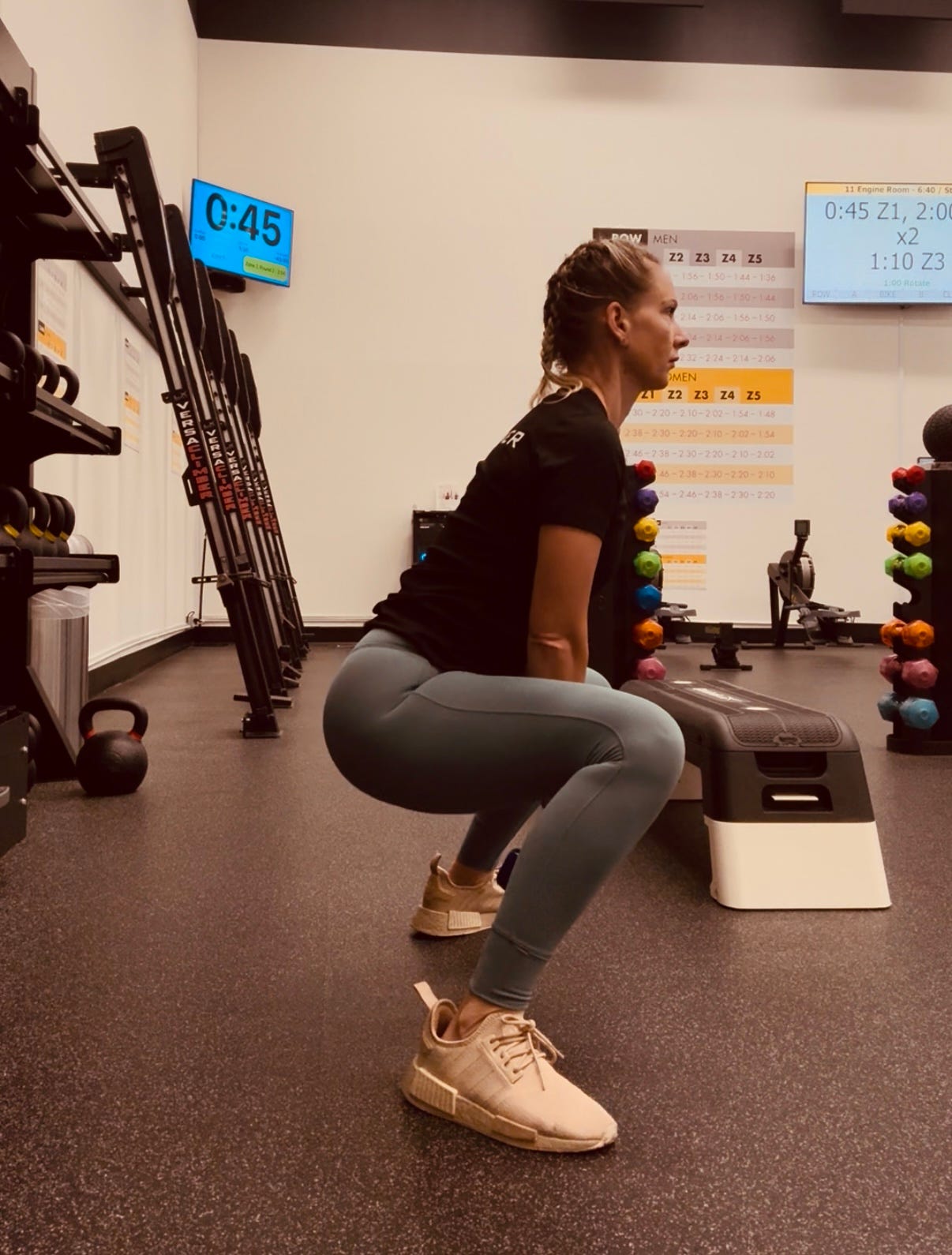
Lower until your thighs are approximately parallel to the floor. Depth depends on your anatomy and mobility. Don’t chase depth at the expense of position.
Drive through your full foot to stand. Press the floor away.
Common Mistakes
Letting the knees cave inward is the most common error and the one that matters most. Knee cave in the sumo squat puts stress on the medial knee and removes the adductor and glute work you came here for. Cue yourself to push knees out throughout the entire rep.
Excessive forward lean is usually a sign of too-narrow a stance or insufficient core bracing. Widen your feet, brace harder, and slow down.
Rushing the descent robs you of time under tension and lets position errors slip through. A controlled lowering phase is where most of the work actually happens.
Toes pointed too far out is a common overcorrection. More is not always better. If your knees aren’t tracking comfortably, you’ve overshot. Find the angle that lets your knees track cleanly over your second and third toes.
How to Program It
The sumo squat fits into a lower body strength session as either a primary or accessory exercise.
As a primary movement, 3 to 4 sets of 6 to 10 reps with a load that challenges you in the last 2 to 3 reps works well. Progressive overload over weeks and months is the goal.
As an accessory after your main compound lift, 2 to 3 sets of 10 to 15 reps gives you additional volume for the adductors and glutes without heavy CNS demand.
Once per week is enough to start. Twice per week is appropriate once you’re comfortable with the pattern.
Want to see exactly how this movement should look in real time, plus a regression if you’re working around mobility limitations, a progression when you’re ready to load heavier, and an alternative if this stance doesn’t work for your hips? Upgrade here.
Paid subscribers also get access to my full exercise video library and progressive training plans built specifically for women in perimenopause, menopause, and postmenopause.
If you’re looking for more personalized 1:1 training, please respond to this E-Mail or send me a message through the Substack app.
