

The Step Down: The Single-Leg Exercise Every Midlife Woman Should Be Training

If you want to know how well your lower body is actually functioning, put yourself on one leg and lower down slowly. What happens next tells you a lot.
The step down is one of the most clinically useful exercises in my toolkit for women in perimenopause, menopause, and postmenopause. It is not a trendy move. It is not complicated. It is one of the most honest assessments of single-leg strength and control you can do with a box and your own bodyweight -- and it translates directly to how your body handles stairs, trails, curbs, and uneven ground.
Why This Exercise Is Important in Midlife
Estrogen plays a significant role in maintaining muscle mass, joint integrity, and neuromuscular coordination. As estrogen fluctuates during perimenopause and declines through menopause and postmenopause, women often experience accelerated loss of lower body strength and a reduction in the quality of muscle contraction, especially through the quadriceps.
This has real consequences for knee health. A prospective cohort study by Slemenda et al. (1997, Annals of Internal Medicine, PMID: 9241928) found that quadriceps weakness preceded radiographic knee osteoarthritis in community-dwelling adults, with women demonstrating disproportionately lower quad strength relative to body weight compared to men. The researchers concluded that strengthening the quadriceps may reduce the risk of symptomatic knee OA progression. This was an observational prospective study; no commercial funding conflicts were reported.
The step down targets exactly that: eccentric quadriceps strength, hip abductor control, and single-leg stability under load. Training it builds the tissue resilience that cushions the knee, and the neuromuscular patterning that keeps you upright when the ground changes under you.
Muscles Worked
The step down is a compound single-leg movement. Primary loading falls on the quadriceps, particularly the vastus medialis oblique, which is the teardrop-shaped muscle just above and medial to the kneecap. It also recruits the gluteus medius, gluteus maximus, hip external rotators, tibialis anterior, and the deep stabilizers of the core and ankle.
In practical terms: it trains your leg to handle load on one side without the pelvis dropping, the knee caving in, or the torso compensating. All three of those patterns are common in midlife women and all three respond well to targeted training.
The Movement
Beginning Position
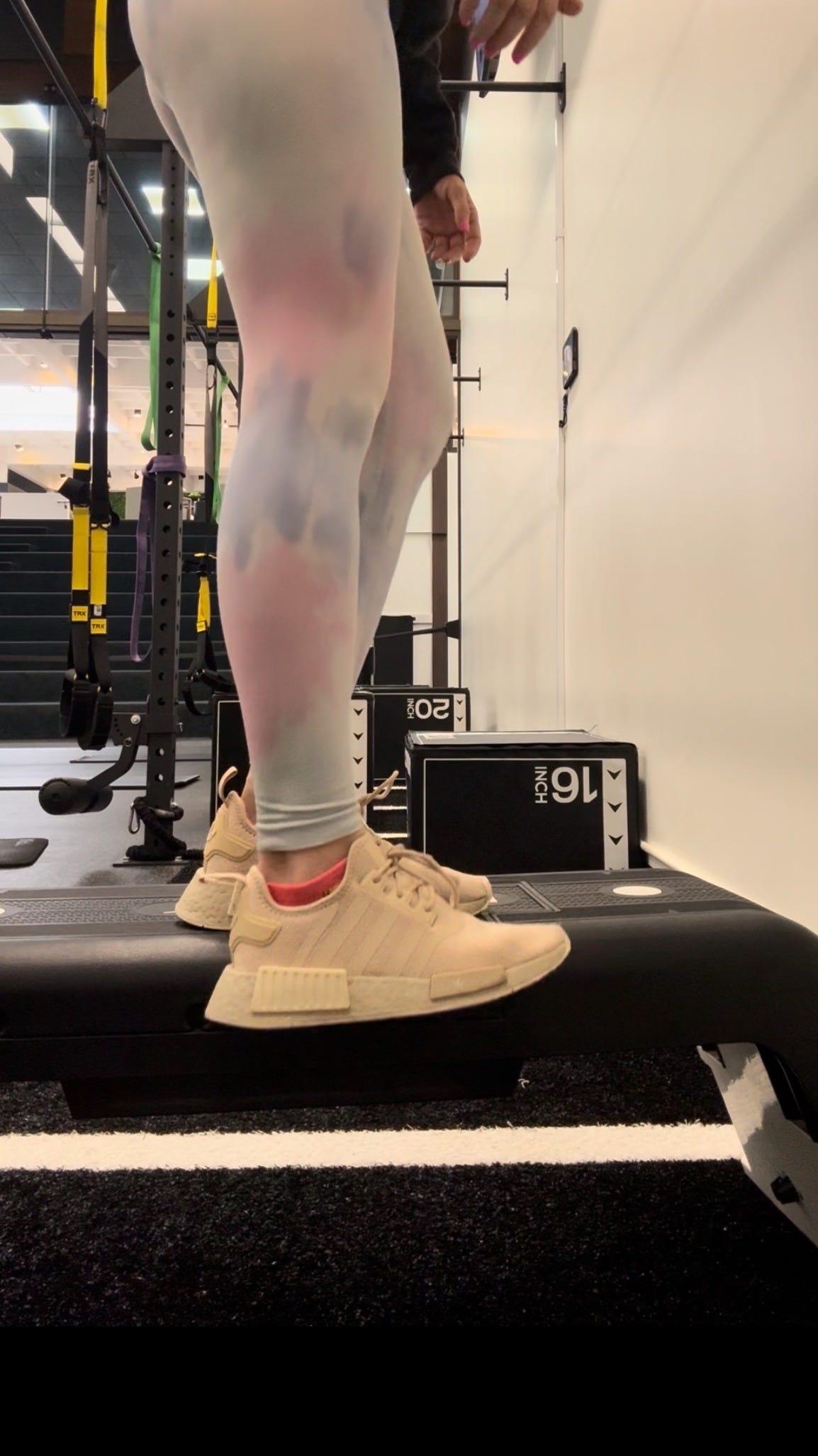
Standing on a step or box, one foot at the edge, other leg hovering.
Finishing Position
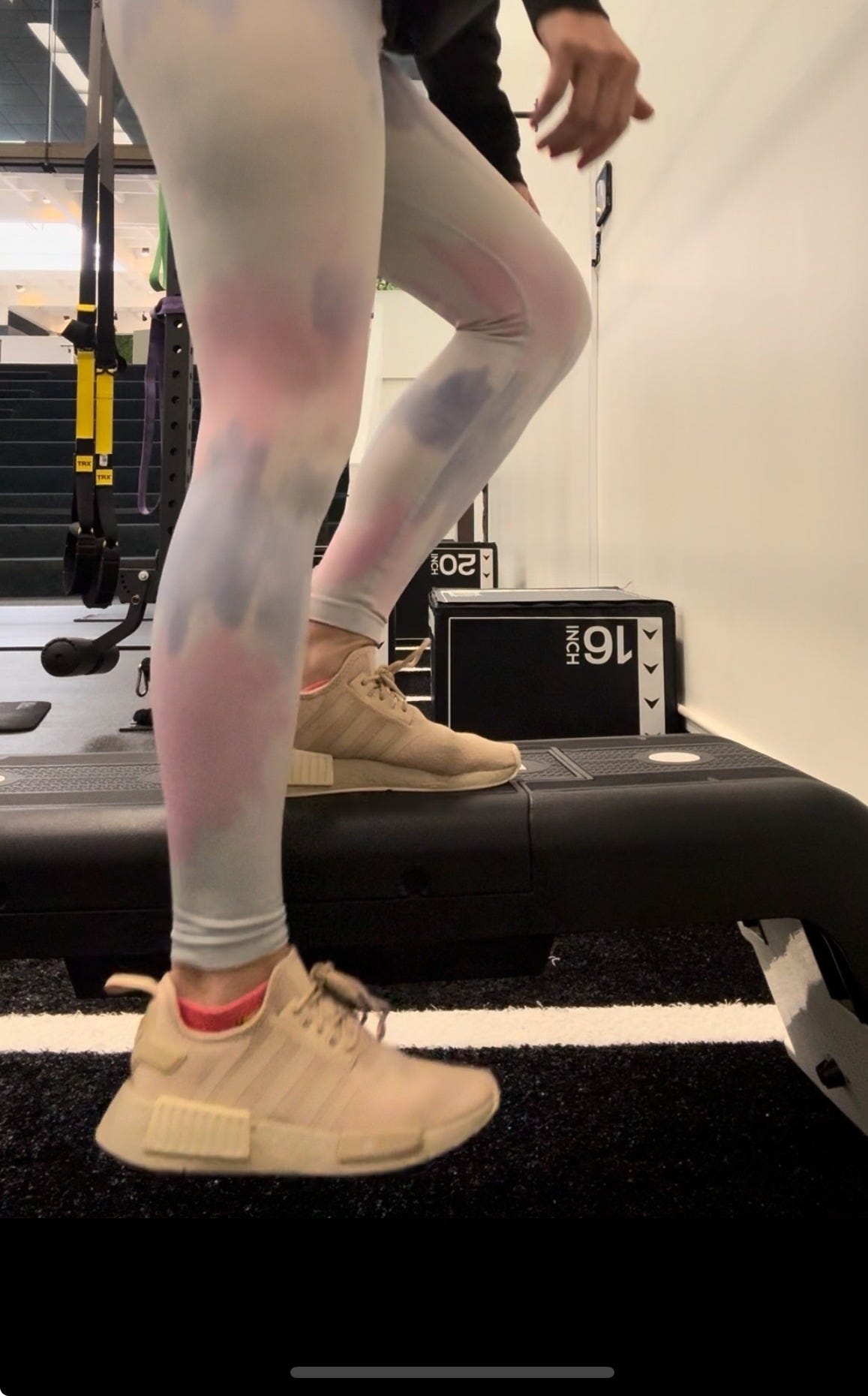
The hovering heel has lowered toward the floor with control. The standing knee tracks over the second toe.
What You Need to Know Before You Try This
Most women I work with have never been coached through the step down. They either skip it entirely or they rush through it and miss the point entirely. The difference between a step down that builds strength and one that just reinforces bad mechanics comes down to a few specific cues.
After the paywall, I walk you through the full coaching video, the most common errors I see in perimenopausal and postmenopausal women, and exactly how to cue your way out of them. I also give you three regressions if the full version is not accessible yet, two progressions when you are ready to load it, and alternatives if you are working around knee or hip limitations.
If your knees have felt less reliable lately, or you have noticed that stairs feel harder than they used to, this is where we start.
