

The Face Pull
The Posterior Shoulder Exercise Midlife Women should have in their training program

If your training leans heavy on pressing, pushing, and the muscles you can see in the mirror, the back of your shoulder is probably underbuilt. The face pull fixes that quietly and well. It trains the rear delts, the mid and lower trapezius, the rhomboids, and the small external rotators of the cuff in one clean pattern. For women moving through perimenopause and beyond, when posture, connective tissue, and shoulder comfort all start shifting, this is one of the highest-value movements you can add to a pull day.
It looks simple. Done well, it earns its place.
What the face pull actually trains
The movement combines three things at once:
Horizontal abduction at the shoulder, driven by the posterior and lateral deltoid
External rotation, driven by the infraspinatus and teres minor
Scapular retraction, driven by the mid and lower trapezius and the rhomboids
That triple action is exactly why it is so useful. Pressing movements load the front of the shoulder and the upper trap. The face pull loads the structures that sit behind and below, the ones that hold your shoulder blade in a stable, well-positioned place when you reach, carry, lift overhead, or sit at a desk for hours.
What the research shows
The closest laboratory analog to a face pull is prone horizontal abduction with full external rotation, which is the same muscle action performed lying face down. A classic EMG study measured exactly this.
Reinold and colleagues recorded muscle activity using fine-wire intramuscular electrodes across seven shoulder exercises in healthy adults. Prone horizontal abduction at 100 degrees with full external rotation produced the highest activation of the posterior deltoid at 88 percent of maximal voluntary contraction, the middle deltoid at 87 percent, and the supraspinatus at 82 percent. A side-lying external rotation position produced the highest infraspinatus activity at 62 percent and teres minor at 67 percent.
In plain terms: the horizontal-abduction-plus-external-rotation pattern that defines a face pull is one of the strongest ways to recruit the rear deltoid and the posterior cuff at the same time.
Anchor study: Reinold MM, Wilk KE, Fleisig GS, et al. Electromyographic analysis of the rotator cuff and deltoid musculature during common shoulder external rotation exercises. J Orthop Sports Phys Ther. 2004;34(7):385-394. PMID: 15296366. DOI: 10.2519/jospt.2004.34.7.385
A few honest limitations. The sample was small at 10 healthy subjects, none of them perimenopausal or postmenopausal women, so the percentages are a guide to muscle recruitment patterns, not a prescription tuned to our population. The face pull itself was not the tested exercise. Prone horizontal abduction with external rotation is the analog, and the cable face pull adds scapular retraction on top. The study used peak isometric values from a single session. No industry funding was indicated in the publication.
How to set it up
Set the cable pulley at about face height. Higher than your hips, roughly level with your eyes or forehead.
Attach a rope. Take a neutral grip (for rear delts and external rotators) with thumbs pointing back toward you or an overhand grip (for more focus on the upper trapezius and rhomboids).
Step back so the cable has tension at the start. Stand tall, ribs down, core braced. This is your start position, arms extended toward the cable.
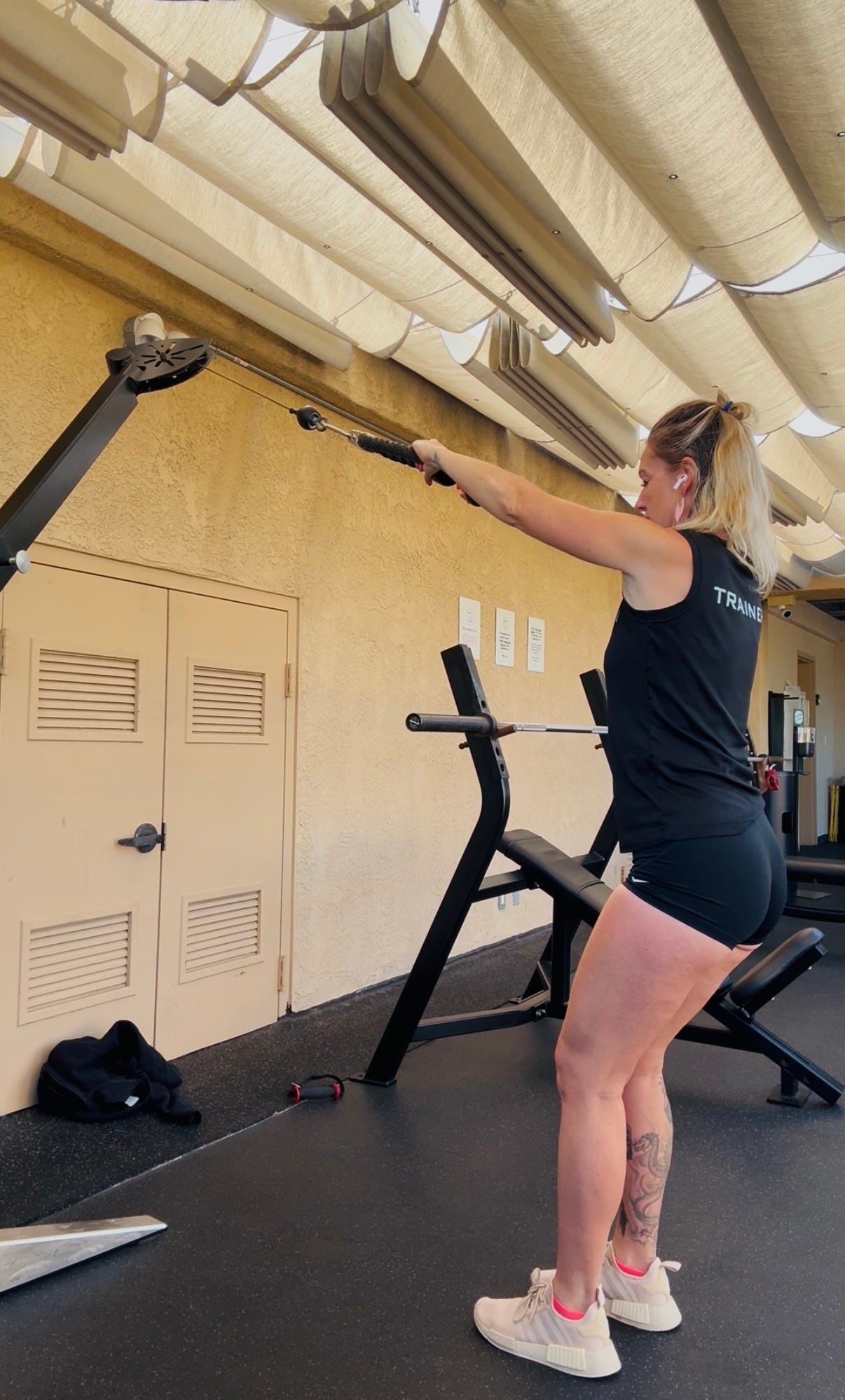
Pull the rope toward your face. Lead with your elbows, keeping them high and wide.
As the rope reaches your face, pull the two ends apart and rotate so your hands finish beside your ears and your knuckles point behind you.
Hold the end position for a beat. Squeeze the shoulder blades together without shrugging.
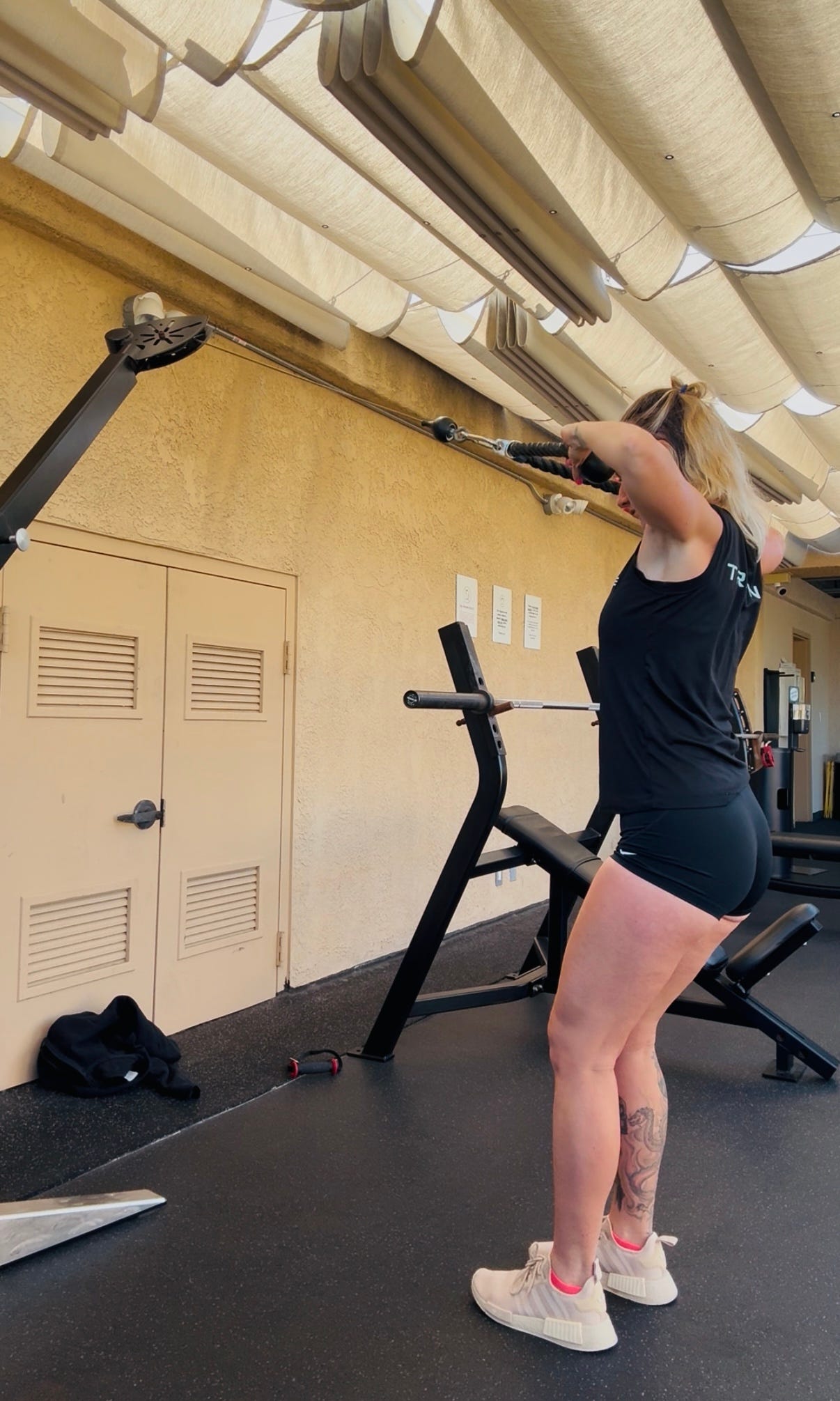
Lower under control. Resist the cable on the way back rather than letting it snap your arms forward.
Load is light to moderate. This is a control exercise, not a max-effort pull. Rep ranges of 12 to 20 suit it well. If your upper traps are doing all the work and creeping toward your ears, the weight is too heavy or the elbows have dropped.
Want the full coaching version?
Below you get the full video, how to make it harder when you are ready, how to scale it back when a shoulder is cranky, what to swap in when you have no cable, and exactly how to program it across perimenopause, menopause, and postmenopause. This is the difference between doing the movement and getting the result.
Paid subscribers have access to all videos as well as the full progressive training plans.
